

Macbeth Lesson 4
What’s Brewing Behind the Witch Scenes in Macbeth
PREREQUISITES: READ Macbeth and “Cauldron of Chaos” in the Macbeth and the Dark Ages volume of NEXUS.
LESSON OBJECTIVES: To explore the Macbeth themes the witches’ words and actions reflect, and to help students understand the meanings of the spells, the role of the Weird Sisters’ familiars Harpier, Graymalkin and Paddock, and which of the witches’ words allude to King James’ experience with the so-called North Berwick witches.
MATERIALS: Word Processor (Word or Pages), pen, notebook, a copy of Macbeth, copy of Macbeth and the Dark Ages, NEXUS
VOCABULARY: witch’s familiar, missives, chastise, valor (British spelling valour), impedes, metaphysical, withal, battlements, direst, access, remorse, compunctious, gall, pall, dunnest
TASK: To match speeches by the witches to source material quoted in this lesson. Then to answer the questions at the end. Carefully read the witch scenes in Macbeth, the “Cauldron of Chaos” in Macbeth and the Dark Ages volume of NEXUS, and this supplement, then answer the questions below.
COMMON CORE STANDARDS MET WITH THIS LESSON:
CCSS.ELA-LITERACY.RL.9-10.2
Determine a theme or central idea of a text and analyze in detail its development over the course of the text, including how it emerges and is shaped and refined by specific details; provide an objective summary of the text.
CCSS.ELA-LITERACY.RL.9-10.3
Analyze how complex characters (e.g., those with multiple or conflicting motivations) develop over the course of a text, interact with other characters, and advance the plot or develop the theme.
CCSS.ELA-LITERACY.RL.9-10.4
Determine the meaning of words and phrases as they are used in the text, including figurative and connotative meanings; analyze the cumulative impact of specific word choices on meaning and tone (e.g., how the language evokes a sense of time and place; how it sets a formal or informal tone).
CCSS.ELA-LITERACY.CCRA.R.6
Assess how point of view or purpose shapes the content and style of a text.
Images Courtesy of Folger Shakespeare Library
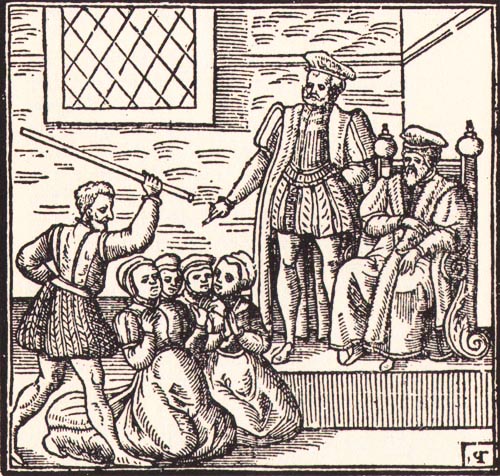
King James and the North Berwick Witches
WITCHCRAFT IN MACBETH and NORTH BERWICK, SCOTLAND [Woodcut of King James interrogating women accused of witchcraft]
Round and about the cauldron go,
In the poisoned entrails throw.
Toad, that under cold stone
Days and nights has thirty-one
In this Macbeth lesson you will read about the 16th-17th century witch mania and then match lines from the witches’ speeches in the play to Shakespeare’s probable source material for those lines. The speeches and source material are quoted below.
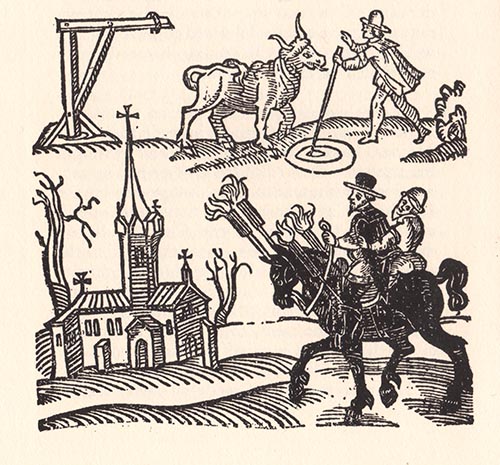
Shakespeare wrote Macbeth during the witch craze of the early 17th-century. In Scotland alone between 1590 and 1635 over 900 people, mostly women, were tried for witchcraft. Throughout Europe an estimated 50,000 were tried and executed. Shakespeare’s audiences would have been keenly interested in the witches and their spells in Macbeth, especially since their new king, James I, had not only written an important book on magic and witchcraft called Daemonology in 1597, but James himself had been an alleged victim of witchcraft in Scotland. Before ascending to the English throne as James I, James was the king of Scotland, James VI. His coronation upon the death of Elizabeth I in 1603 united Scotland and England, thus he is known as both James VI and I. In 1589 the 23-year–old James VI of Scotland married the fifteen-year-old princess Anne of Denmark. While sailing to Scotland to join her new husband, powerful storms hammered Anne’s ship, forcing it land in Norway. Some Danish leaders attributed the storm to witchcraft, believing several Danish “witches” opposed the royal marriage. (It was believed a witch could summon a storm by slapping a river with her broom. Thunder storms were often associated with witchcraft.) Since his queen could not come to him, James sailed for Denmark. Returning to Scotland in 1590, James’ and Anne’s ship was also assaulted by a powerful tempest. Eventually the witches of North Berwick, Scotland, after severe interrogation which included horrendous torture, confessed to summoning this storm to kill James and his new queen. During the North Berwick witch trials of 1591 and 92, James interrogated some of the alleged witches himself. One of the accused, a woman named Ewfemia McCalzeane, admitted (under torture) that she sailed out to sea in a sieve and sang chants designed to sink the king’s ship (for details see “Cauldron of Chaos” in Macbeth and the Dark Ages). Another accused “witch,” Agnes Thompson confessed to tying human body parts to a cat and then throwing it into the sea as part of a spell to sink the king and queen’s ship. James initially believed the accused women’s stories were far-fetched and called them all liars. Then one of the accused, curiously upset that the king didn’t believe her stories, one of the women wanted James to believe her spells. She called the king aside and told him (according to a contemporary bulletin, Newes from Scotland) the exact words he said to his new wife on their wedding night as well as the bride’s reply. James was astonished and afterward believed the accused were truly witches in league with the devil. Because the witches had personally sought his death, James came to view witchcraft as not merely a religious crime against God and his church, but a crime against the crown and state. Macbeth reflects this view, which was unusual at the time. No other European monarch of the period appears to have shared this perspective.
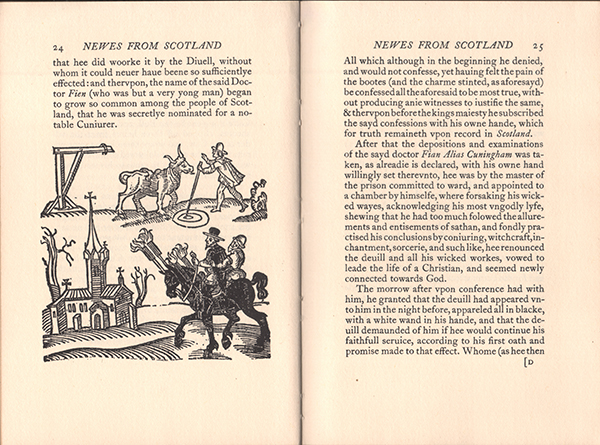
WHY WOULD A WITCH SAIL IN A SIEVE, which is after all full of holes? Unlike the Wicked Witch of the West in The Wizard of Oz, witches were presumed to be water-proof – in a way. For example, many people believed that if a witch were thrown in water she or he would float rather than sink because water, which was considered holy, would reject their evil bodies and more or less spit them out. Because of this superstition, the “water ordeal” was a part of an alleged witch’s trial. Since witches were supposedly “water-proof,” many claimed witches could safely sail the seas in sieves and even in seashells and egg shells. This along with other superstitions led to the conviction of more than 30 North Berwick “witches,” most of whom were hanged or burnt – all of whom were undoubtedly innocent. According to Newes from Scotland, a 1591 pamphlet that covered the trials (which lasted two years), 200 witches sailed the sea in sieves to a great coven meeting in North Berwick to plot the murder of the king.
Witch Talk in Macbeth

In the play the first witch claims to sail in a sieve to harass a sailor whose wife insulted her.
Witch 1: A sailor’s wife had chestnuts in her lap
And munched, and munched, and munched. ‘Give me,’ quoth I.
‘Aroint thee, witch’, the rump-fed ronyon cries.
Her husband’s to Aleppo gone, master o th’Tiger*;
But in a sieve I’ll thither sail
And, like a rat without a tail,
I’ll do, I’ll do, and I’ll do.
Witch 2: I’ll give thee a wind.
Witch 3: And I another.
Witch 1: I myself have all the other,
And the very ports they blow,
all the quarters that they know
I’th’shipman’s card.
I’ll drain him dry as hay:
Sleep shall neither night nor day
Hang upon his penthouse lid;
He shall live a man forbid.
Weary sennights nine times nine,
Shall he dwindle, peak, and pine.
Though his bark cannot be lost,
Yet it shall be tempest-tossed.
Look what I have.
Witch 2: Show me, show me.
Witch 1: Here I have a pilot’s thumb,
Wrecked as homeward he did come.
The insult “Rump-fed ronyon” is the witch’s way of saying the sailor’s wife is well-fed. (Remember, when Macbeth and Banquo first meet the witches, Banquo exclaims, “What are these,/So withered and so wild in their attire.” Thin, ill-fed women were often accused of being witches.) A ronyon is a scabby creature and rump-fed means a large behind, but may also suggest that the woman is so well provided for that she can sit around from dawn to dusk munching on anything she likes. To avenge herself upon this well-fed woman for refusing to share her chestnuts, the witch plans to assault the woman’s husband while he’s at sea. The reference to a witch in a sieve would ring loudly in the ears of those familiar with their new King’s experience with the so-called North Berwick witches approximately sixteen years earlier.
Many believed that while a witch could assault a ship with a storm, she or he couldn’t actually sink one if the people on board were sufficiently devoted to God. Thus, Witch 1 says, “Though his bark (boat) cannot be lost,/Yet it shall be tempest-tossed.” Although witches allegedly possessed supernatural powers, “witch experts” claimed that God set limits on what they could and couldn’t do. After King James’s ship was supposedly assailed at sea, he became an “expert” on witchcraft and seven years later wrote a book on the subject called Daemonologie, which was used in many subsequent witch trials.
An earlier book on witchcraft, Malleus Maleficarum, known as the Hammer of the Witches and published in 1486, was used widely throughout Europe during the 16th and 17th centuries. It may have been consulted at the North Berwick witch trials.
In Act IV, Scene 1 the witches brew a wicked broth in a cauldron.
WITCHES: Double double toil and trouble;
Fire burn and cauldron bubble.
The ingredients of their hell-broth include the usual toad, newt, snake, frog, and bat, but surprisingly the witches also toss in the body parts of non-Christians – “Nose of Turk, and Tartar’s lips.” Most shockingly they add the “finger of a birth-strangled babe.” According to Malleus Maleficarum (aka Hammer of the Witches) the ultimate goal of witches was to depopulate the Christian world and win souls for the devil. To achieve this end, it was believed witches murdered un-baptized infants so that they would go directly to hell.
For the same purpose, the Hammer of the Witches states “witches tried to prevent women from conceiving, or made them miscarry. ‘A third and fourth method of witchcraft is when they have failed to procure an abortion, and then either devour the child or offer it to the devil.’” (from “Cauldron of Chaos,” Macbeth and the Dark Ages). Not surprisingly Macbeth unwittingly helps the witches achieve their goal by murdering Macduff’s children.
The rest of this scene is examined in “Cauldron of Chaos,” in the NEXUS volume Macbeth and the Dark Ages.
*The Tiger was an English merchant ship that nearly sank in 1606 after a 567-day voyage.

QUESTIONS
QUESTIONS
- What book on witchcraft did King James I write (before becoming king of England?
- Explain James's view of the divine right of kings to rule and apply it to Macbeth.
- Who were the North Berwick witches and what is their connection to James I?
- What words in the play seem to have been inspired by the North Berwick witches?
- Witches were believed to have power to evoke storms. How did they supposedly do this?
- Why did the witches use body parts in their rituals in the play?
- What lines in the witch scenes suggest that the familiars Harpier, Paddock and Graymalkin are "divining familiars" that help the witches predict the future?
- Macbeth's first words echo the witches' line "Fair is foul and foul is fair." What does this suggest?
- Three witches give three different greetings to Macbeth. If you put yourself in Macbeth's shoes, how would the order of the greetings affect you?
- Banquo says to the witches: "If you can look into the seeds of time/And say which grain will grow and which will not,/Speak then to me…" Identify the metaphor in these lines. How do the witches "look into the seeds of time" according to the chapter "Cauldron of Chaos" in NEXUS? [If you do not have access to the NEXUS book Macbeth and the Dark Ages, you will need to track down other sources to answer this question.]
EXTRA CREDIT – Write an essay on WOMEN, MIDWIVES & WITCHCRAFT.
Have students explore the prejudice against women that was often at least partly behind accusations of witchcraft. As discussed in the NEXUS chapter, "Cauldron of Chaos," this prejudice was reinforced by Malleus Maleficarum, also known as "The Hammer of Witches," written in 1486, which states: "Women are intellectually like children" and "No one does more harm to the Catholic faith than midwives." In your essay you should address these questions: Were midwives often the targets of witch hunters? What evidence suggests this? What evidence refutes it? USE and CITE at least three sources besides "Cauldron of Chaos" in the Macbeth and the Dark Ages volume of NEXUS.
Image Courtesy of Folger Shakespeare Library
NEXUS – PALLAS COMMUNICATIONS, INC.
© 2019 All Rights Reserved