

Julius Caesar Lesson 2
Portia and Calpurnia – A Market Meetup
PREREQUISITES: READ Acts I and II of Julius Caesar
LESSON OBJECTIVES: By writing and performing their own scene, students will better recognize the role dialogue and character interaction (what is said and what is suggested) play in advancing the plot; they will learn to identify character traits from speech patterns and write in-character dialogue; and they will learn how to block a scene and use vocal dynamics when performing (or reciting or in any form of public speaking). To help students better understand and appreciate Shakespeare’s figurative language, they will include two metaphors and two antitheses in their scripts. To assist students in writing antitheses and metaphors, have them complete our HOW TO PEN PUNS, METAPHORS, AND ANTITHESES online lesson.
MATERIALS: Word Processor (Word or Pages), pen, notebook, a copy of Julius Caesar, a recording device, and long robes or gowns.
TASK: Pair up and add a scene in the style of Shakespeare at the end of Act II of Julius Caesar. In your scene, Calpurnia and Portia will meet at the outdoor market in the Roman Forum just before and during the assassination of Julius Caesar.
COMMON CORE STANDARDS MET WITH THIS LESSON:
CCSS.ELA-LITERACY.RL.9-10.3
Analyze how complex characters (e.g., those with multiple or conflicting motivations) develop over the course of a text, interact with other characters, and advance the plot or develop the theme.
CCSS.ELA-LITERACY.RL.9-10.4
Determine the meaning of words and phrases as they are used in the text, including figurative and connotative meanings; analyze the cumulative impact of specific word choices on meaning and tone (e.g., how the language evokes a sense of time and place; how it sets a formal or informal tone).
Image Courtesy of Folger Shakespeare Library
Writing a Scene
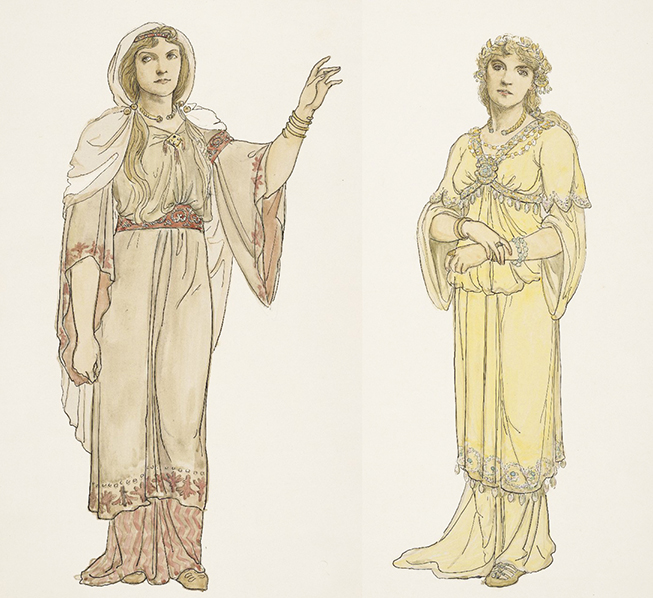
Pair up and add a scene in the style of Shakespeare between acts II and III of Julius Caesar. In your scene, Calpurnia and Portia will meet at the outdoor market in the Roman Forum just before and during the assassination of Julius Caesar. Remember, the previous night Calpurnia dreamed that Caesar would be slain that day, and Brutus has revealed the assassination plot to Portia. Also remember that Portia has admitted to herself that it’s difficult to keep her husband’s secret. Both women are extremely anxious.
________________________________________________________________________________
Portia: O constancy, be strong upon my side;
Set a huge mountain ‘tween my heart and tongue
I have a man’s mind and woman’s might.
How hard it is for women to keep counsel! [to keep a secret].
________________________________________________________________________________
In your scene while shopping (or pretending to shop) the two wives will meet by chance in the market place. Calpurnia, overwrought with worry, relates her dream to Portia. How will Portia react? [NOTE: Although Portia is the daughter of the Stoic Cato, her emotions just got the better of her a few minutes earlier in her interaction with the servant Lucius (Act II, Scene 4).]
________________________________________________________________________________
Portia: I prithee, boy, run to the Senate House;
Stay not to answer me, but get thee gone.
Why dost thou stay?
Lucius: To know my errand, madam.
Portia: I would have had thee there and here again
Ere I can tell thee what thou shouldst do there.
_________________________________________________________________________________
Portia: I must go in. Ay me, how weak a thing
The heart of woman is! O Brutus
The heavens speed thee in thine enterprise!
Sure, the boy heard me – Brutus hath a suit
That Caesar will not grant – O, I grow faint.
Run, Lucius, and commend me to my lord;
Say I am merry; come to me again,
And bring me word what he doth say to thee.
_________________________________________________________________________________
WHEN WRITING THE DIALOGUE, MIMIC EACH WOMAN’S STYLE OF SPEECH BY EXTRAPOLATING FROM HER SCENES IN ACT II.
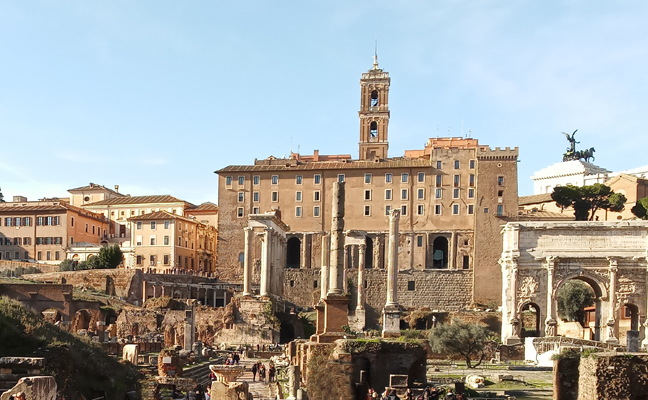
Photograph of Roman Forum ruins by Don M. Bryant
Backstory
-
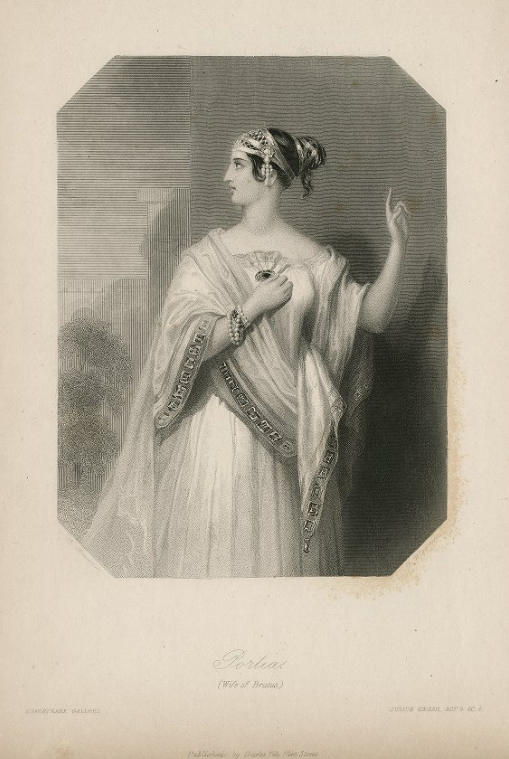
- Since Caesar treated Brutus as a son, he and Calpurnia probably occasionally socialized with Brutus and Portia; therefore it’s natural for the two women to talk together upon encountering each other in the market.
- Before you can create believable dialogue, you must know your characters. Make a list of what we know about Calpurnia and Portia from the play. For example, was Calpurnia as well-read as Portia? (Discover what else you can about their characters from outside sources.) If not, would her vocabulary be as rich as Portia’s? Was Calpurnia more or less intuitive than Portia, more or less superstitious in that highly superstitious age? If so, then you should find a way to show this in your scene – through Calpurnia’s word choices, behavior and actions.
- You must give each woman a reason for going to the market and for not sending a servant or slave to make her purchases. Maybe one of the women doesn’t want to make a purchase, but simply needs to get out of her house. Maybe the other wants to purchase something to help her to calm down. What other possibilities can you think of?
- Remember these are patrician women, which means they must act according to the highest Roman standards of decorum, especially in public. Calpurnia unofficially represents her husband Julius Caesar, the most powerful man in the Empire, and Portia is the representative of both Brutus, the noblest man in the Empire, and her pro-Republic father, the Stoic senator Cato. How would the wife of Brutus behave in public? What kinds of things would she buy that are suitable to her class and to Brutus’s stoical lifestyle? Would Calpurnia be more likely to buy lavish things than Portia? How would the wife of Caesar walk? What kind of bearing would she have? Would Portia be deferential to Calpurnia, given Caesar’s position and power. These are the kinds of questions you should ask yourself before writing your scene. Also, you should reread all the Portia and Calpurnia scenes several times. As you do so, try to picture these women in your mind: how they stand, move and speak.
Photograph of Roman Forum and Triumphal Arch by Don M. Bryant
Blocking and Setting Lesson
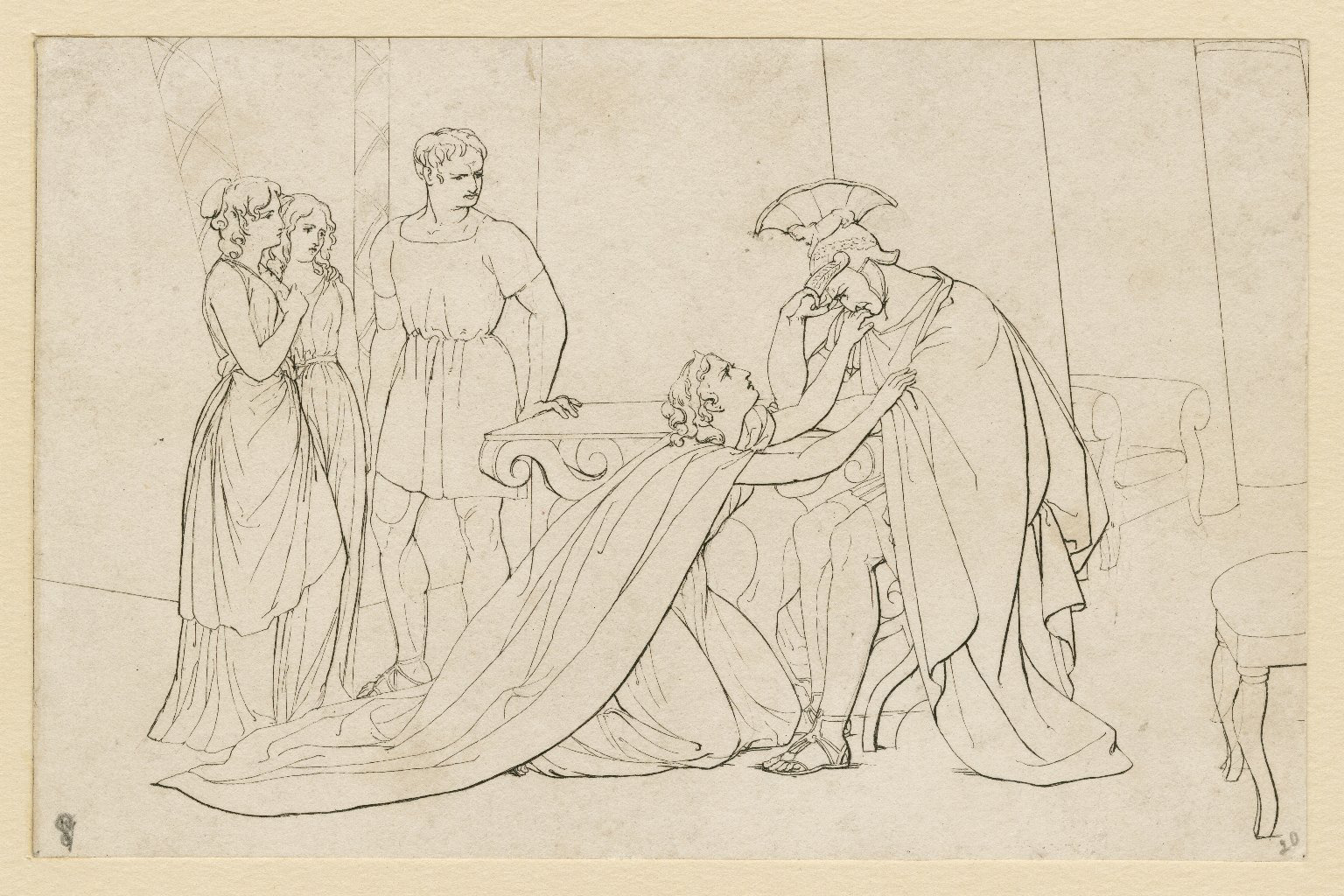
BLOCKING a scene means positioning the actors with respect to one another and to their location (the setting) – sitting, standing or laying down, looking up or down, etc. The director must determine in advance where each character will stand or sit in relation to the other character(s) and where and how she or he will move – even when alone.
MOVEMENT should help convey each character’s mood and feelings. For example, how does a person move when she or he is anxious, frightened, or calm? Each mood will affect how the women move differently.
POSITIONING can help show an actor’s attitude, the affect of the surroundings on her mood, the relationship between characters: a person in charge might sit while the other character stands. When positioning characters, the director must also make sure that the audience can clearly see the actors.
Also remember that directors show actors at their most dramatic angles to intensify dramatic moments in a play or film. Usually, they are shown from the front or the profile.
SETTING – location and ambiance can help convey mood, indicate social and economic status (expensive furniture in a home versus dilapidated furniture), and even affect behavior (someone watching a baseball game in a stadium will usually behave quite differently than someone in a church, mosque or synagogue).
During this market scene each woman must carry out actions related to shopping. For example, Calpurnia might examine dried fruits (remember it’s the middle of March so the produce won’t be fresh) while she’s speaking to Portia, or vice versa. The women should focus on market products that somehow reflect their emotional states. For example, is it likely that either woman would shop for clothes at such a time? Would either woman be able to concentrate fully on shopping? Be creative in your scene. Perhaps Portia will examine bottles of red wine and speak of them to Calpurnia, but the latter won’t be able to look at the red bottles because they remind her of blood. Maybe one of the women is so distracted she doesn’t realize what produce or products she is looking at.
Figurative Language Lesson
FIGURATIVE LANGUAGE
SHAKESPEARE employs not just doths, thous and thines, hithers and thithers; he also makes ample use of figurative language. For how to write figurative language, see Penning Puns, Metaphors, and Antitheses under LESSON PLANS, Romeo and Juliet.
Vocal Dynamics Lesson

What are Vocal Dynamics?
When a parent wants a teenager to clean her or his room (which has NOT been properly cleaned in weeks), she might yell, “CLEEAAN your room” prolonging the word she wants to stress. Or, she might shout it: “Clean!” Or she might say, “clean YOUR room” to emphasize that it is YOUR responsibility to keep YOUR room clean.
To make a scene seem natural, you must include vocal dynamics:
RAISING THE VOICE in anger or to get someone to focus on the point being made.
LOWERING THE VOICE so no one else overhears something controversial, dangerous, or compromising that the character might say.
SPEEDING UP (to show excitement or frustration) or slowing down a sentence.
PAUSING to emphasize a point and let it sink in – don’t ever say THAT….again.” Or pausing simply to let your thoughts catch up to your mouth.
We do ALL these things naturally, usually without thinking about them in conversation. Unfortunately, when reading or reciting dialogue, non-actors tend to leave out natural vocal dynamics. BE SURE TO INCLUDE THEM so your scene doesn’t sound flat and unnatural. In real life, no one speaks consistently at one volume and one tempo. Our voices modulate according to our moods and emotions. You might also include sounds like “hmmm,” “ah-ha,” laughs, chuckles, snickers, groans, etc.
To indicate the vocal dynamics in your Calpurnia-and-Portia dialogue, we ask you to borrow [adopt] the dynamics symbols (or terms) of music:
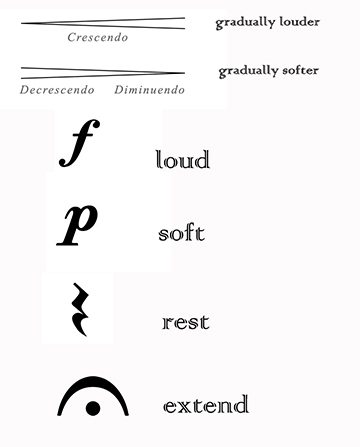
PRACTICE USING DYNAMICS SYMBOLS:
- LISTEN to a short conversation or record one from a television show or movie. Then transcribe the conversation and add the dynamics symbols in the appropriate places.
- NOTATE the vocal dynamics of the first scene of Julius Caesar (between Flavius, Marullus, the Carpenter and the Cobbler). You may use a film version of the play or simply copy the text and place the symbols where you think they belong.
- NOW YOU ARE READY to incorporate VOCAL DYNAMICS into your script. Thoughtfully place the vocal dynamics symbols in your text, then practice using them. REMEMBER: You are not RECITING lines, you are PUTTING LIFE into them. BUT DON’T OVER DO IT (i.e., don’t overact).
RECORD SEVERAL OF YOUR REHEARSALS, LISTEN CAREFULLY TO THE RECORDINGS TO DISCOVER WHERE YOU CAN IMPROVE THE SCRIPT, ACTING and VOCAL DYNAMICS.
PLAYWRIGHT AND TEACHER JEAN-CLAUDE VAN ITALLIE says that “It is commonly said that for any scene or play to be dramatic the characters must be in conflict. Conflict in a play has been called ‘the magic essential.’” What is the “MAGIC ESSENTIAL” in your Portia/Calpurnia scene?
Theater Critic
Learning from Reviewing and from Reviews

PART II
EACH STUDENT SHOULD CRITIQUE SOME OR ALL OF HER CLASSMATES’ SCENES USING THE FOLLOWING CRITERIA:
A) How natural and interesting is the dialogue?
B) How Shakespeare-like is the dialogue? Are the metaphors and antitheses relevant, effective and Shakespearean?
C) Are the characters true to Shakespeare’s creations? If not, how do they differ?
D) How convincing is the acting?
E) Is the blocking natural? Does it help to convey each character’s feelings?
F) Did both actors use vocal dynamics? If so, were the vocal dynamics realistic and dramatic?
G) Was the shopping scene realistic? If so, how? If not, why?
H) Does the scene have a “magical essential”?
I) Offer suggestions for improvement.
NEXUS – PALLAS COMMUNICATIONS, INC.
© 2018 All Rights Reserved