

Julius Caesar Lesson 1
Caesar’s Last Mile – Writing a Scene
RECOMMENDED: READ Acts I, II and III of Julius Caesar.
LESSON OBJECTIVES: By writing and performing their own scene, students will better recognize the role dialogue and character interaction (what is said and what is suggested) play in advancing the plot; they will learn to identify character traits from speech patterns and write in-character dialogue; and they will learn how to block a scene and use vocal dynamics when performing (or reciting or speaking to an audience). To help students better understand and appreciate Shakespeare’s figurative language, they will include two metaphors and two antitheses in their scripts. To assist students in writing antitheses and metaphors, have them complete our HOW TO PEN PUNS, METAPHORS AND ANTITHESES online lesson.
MATERIALS: Word Processor (Word or Pages), pen, notebook, a copy of Julius Caesar, a recording device, and long robes to suggest togas.
TASK: Working in groups of three, plan, write, and perform a scene inserted at the end of Act II of Julius Caesar. In this scene Julius Caesar and the conspirators will walk from Caesar’s home to the Theater of Pompey, where the assassination takes place. What do the conspirators say to Caesar during the walk? How do they cloak their intentions from the perceptive Caesar? Write the dialogue in Shakespearean English and include at least two antitheses and two metaphors (students may use similes and personifications as special types of metaphors).
COMMON CORE STANDARDS MET WITH THIS LESSON:
CCSS.ELA-LITERACY.RL.9-10.3
Analyze how complex characters (e.g., those with multiple or conflicting motivations) develop over the course of a text, interact with other characters, and advance the plot or develop the theme.
CCSS.ELA-LITERACY.RL.9-10.4
Determine the meaning of words and phrases as they are used in the text, including figurative and connotative meanings; analyze the cumulative impact of specific word choices on meaning and tone (e.g., how the language evokes a sense of time and place; how it sets a formal or informal tone).
Image Courtesy of Folger Shakespeare Library
Creating a Scene
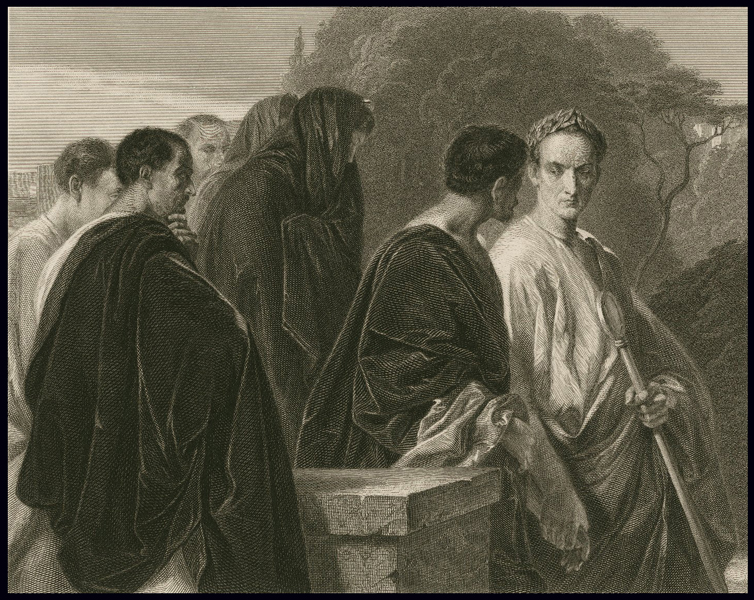
ACT II, SCENE 1, LINES 224-227
Brutus: Good gentlemen, look fresh and merrily.
Let not our looks put on our purposes,
But bear it as our Roman actors do,
With untired spirits and formal constancy.
Between the end of Act II, Scene 2 and Act III, Scene 1, Julius Caesar and the conspirators walk roughly one mile from Caesar’s home to Pompey’s Theater, the site of the assassination. During that time the conspirators hide their intentions from the perceptive Caesar by behaving as Brutus advised: “Look fresh and merrily./Let not our looks put on our purposes.”
What do you think they discuss to distract Caesar during the last walk of his life? For this lesson team up with two other students and write a CAESAR’S LAST MILE scene in the style of Shakespeare, primarily focusing on the conversation between Caesar, Brutus and Cassius, but let two of the other conspirators speak some lines as well. Give voices to those conspirators by having one member of your team play several roles. Make sure your scene provides a seamless bridge to Act III, Scene 1 (before the Capital).
Before you begin writing, reread Caesar’s, Brutus’s, Cassius’s, and Casca’s speeches in Act I and Act II. What distinguishes Caesar’s style of speaking from Brutus’s and Cassius’s? What distinguishes Brutus’s from Cassius’s and Casca’s? Make a list of phrases or sentences that reflect each character’s manner of speaking and personality. For Casca, use his exchange with Brutus and Cassius in Act I, Scene 2, lines 214 – 294 (note how Brutus and Cassius describe Casca after speaking with him.)
Adding Drama

Then write your scene, bearing in mind that Caesar was a very discerning reader of human nature. The conspirators in your scene will have to be quite clever to conceal their intentions from such a perceptive man. Recall what Caesar says about Cassius in Act 1, Scene 2:
Yond Cassius has a lean and hungry look;
He thinks too much: such men are dangerous.
[For examples of Julius Caesar’s actual insights into human nature see “Shakespeare and Caesar, Mysteries of the Mind,” in NEXUS, Julius Caesar and Ancient Rome, from Republic to Empire or read all or part of The Civil War by Julius Caesar.]
To make your scene dramatic, have one of the conspirators almost give away the plot during the walk, perhaps by a Freudian slip. If the blunt Casca utters something unintentionally revealing, who would be most likely to cover up his blunder, Brutus or Cassius? How might Brutus or Cassius conceal Casca’s slip of the tongue?
HINTS FOR MAKING YOUR SCENE SUSPENSEFUL
As you plan the walk, put yourself in each character’s shoes. Try to feel Cassius’s envious feelings as you compose his lines by recalling when you felt envy or jealousy, then infuse Cassius’s emotions with your own. When you’re writing Brutus’s lines, imagine his conflicted emotional state as he mentally prepares himself to kill a man he loves. (Recall a situation in which your own emotions were conflicted; that can help you walk convincingly in Brutus’s shoes). Remember Brutus expresses regrets about assassinating Caesar in Act II. The lines below in blue offer suggestions to an actor (and a director) as to how Brutus might behave during Caesar’s last walk. (To access the entire play online use either of these links: Shakespeare.MIT.edu or Folger Shakespeare.)
______________________________________________________________
ACT II, SCENE 1
Since Cassius first did whet me against Caesar line 61
I have not slept.
Between the acting of a dreadful thing
And the first motion, all the interim is
Like a phantasma, or a hideous dream.
The genius and the mortal instruments
Are then in council, and the state of a man
Like to a little kingdom, suffers then
The nature of an insurrection. line 69
______________________________________________________________
They are the faction. O conspiracy, line 77
Sham’st thou to show they dang’rous brow by night,
When evils are most free? O, then by day
Where wilt thou find a cavern dark enough
To mask thy monstrous visage? Seek none, conspiracy;
Hide it in smiles and affability:
For if thou path, thy naïve semblance on,
Not Erebus itself were dim enough
To hide thee from prevention.
______________________________________________________________
O, that we then could come by Caesar’s spirit, line 169
And not dismember Caesar! But, alas,
Caesar must bleed for it. And, gentle friends,
Let’s kill him boldly, but not wrathfully…
BRUTUS TO PORTIA
…I will construe to thee line 307
All the charactery of my sad brows.
______________________________________________________________
ACT II, SCENE 2
Brutus [aside] That every like is not the same line 128
The heart of Brutus earns to think upon.
______________________________________________________________
IN YOUR SCENE, MAKE BRUTUS SAY SOMETHING THAT SUGGESTS HE’S HAVING SECOND THOUGHTS ABOUT ASSASSINATING CAESAR. WHEN CASSIUS NOTICES THIS WAVERING IN HIS FRIEND, WHAT WILL HE SAY OR DO TO STEER BRUTUS BACK ON TRACK – WITHOUT GIVING AWAY THE PLAN?
A Brief Blocking and Setting Lesson

BLOCKING a scene means positioning the actors with respect to one another and to their location (the setting) – sitting, standing or laying down, looking up or down, etc. The director must determine in advance where each character will stand or sit in relation to the other character(s) and where and how she or he will move – even when alone.
MOVEMENT should help convey each character’s mood and feelings. For example, how does an individual move when he is hiding something; how does a man move who is wrestling with conflicting feelings? Even a collective mood will affect each character differently.
POSITIONING can help show an actor’s attitude, the affect of the surroundings on his mood, the relationship between characters: a person with authority will move and carry himself differently than the people under him. When positioning characters, the director must also make sure that the audience can clearly see the actors.
Also remember that directors show actors at their most dramatic angles to intensify dramatic moments in a play or film. Usually, they are shown from the front or the profile.
SETTING – location and ambiance can help convey mood, indicate social and economic status (expensive furniture versus dilapidated furniture), and even affect behavior (someone watching a baseball game in a stadium will usually behave quite differently from someone in a church, mosque or synagogue).
During this walking scene each conspirator should move with a forced naturalness through the setting – the streets of Rome. How will Caesar move? Will Calpurnia’s dark dream affect him, make him suspicious of those around him or those he passes on the street? Or will his extreme self-confidence brush any creeping fears aside?
Figurative Language
FIGURATIVE LANGUAGE
SHAKESPEARE employs not just doths, thous and thines, hithers and thithers; he also makes ample use of figurative language. For how to write figurative language, see Penning Puns, Antitheses, and Metaphors under LESSON PLANS, Romeo and Juliet.
Vocal Dynamics Lesson
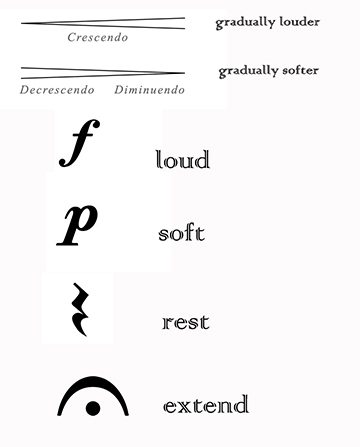
What are Vocal Dynamics?
When a parent wants a teenager to clean her or his room (which has NOT been properly cleaned in weeks), she might yell, “CLEEAAN your room” prolonging the word she wants to stress. Or, she might shout it: “Clean!” Or she might say, “clean YOUR room” to emphasize that it is YOUR responsibility to keep YOUR room clean.
To make a scene seem natural, you must include vocal dynamics:
RAISING THE VOICE in anger or to get someone to focus on the point being made.
LOWERING THE VOICE so no one else overhears something controversial, dangerous, or compromising that the character might say.
SPEEDING UP (to show excitement or frustration) or slowing down a sentence.
PAUSING to emphasize a point and let it sink in – don’t ever say THAT….again.” Or pausing simply to let your thoughts catch up to your mouth.
We do ALL these things naturally, usually without thinking about them in conversation. Unfortunately, when reading or reciting dialogue, non-actors tend to leave out natural vocal dynamics. BE SURE TO INCLUDE THEM so your scene doesn’t sound flat and unnatural. In real life, no one speaks consistently at one volume and one tempo. Our voices modulate according to our moods and emotions. You might also include sounds like “hmmm,” “ah-ha,” laughs, chuckles, snickers, groans, etc.
To indicate the vocal dynamics in your scene, we ask you to borrow [adopt] the dynamics symbols (or terms) of music:
PRACTICE USING DYNAMICS SYMBOLS:
- LISTEN to a short conversation or record one from a television show or movie. Then transcribe the conversation and add the dynamics symbols in the appropriate places.
- NOTATE the vocal dynamics of the first scene of Julius Caesar (between Flavius, Marullus, the Carpenter and the Cobbler). You may use a film version of the play or simply copy the text and place the symbols where you think they belong.
- NOW YOU ARE READY to incorporate VOCAL DYNAMICS into your script. Thoughtfully place the vocal dynamics symbols in your text, then practice using them. Remember: You are not RECITING lines, you are PUTTING LIFE into them. But don’t overdo it (i.e., don’t overact).
RECORD SEVERAL OF YOUR REHEARSALS, LISTEN CAREFULLY TO THE RECORDINGS TO DISCOVER WHERE YOU CAN IMPROVE THE SCRIPT, ACTING AND VOCAL DYNAMICS.
Playwright and teacher JEAN-CLAUDE VAN ITALLIE says that “It is commonly said that for any scene or play to be dramatic the characters must be in conflict. Conflict in a play has been called ‘the magic essential.’” What is the “MAGIC ESSENTIAL” in your CAESAR’S LAST MILE scene?
Theater Critic
Learning from Reviewing and from Reviews
PART II
EACH STUDENT SHOULD CRITIQUE ANOTHER TEAM’S SCENE USING THE FOLLOWING CRITERIA:
A) Is the dialogue both naturalistic and Shakespeare-like?
B) Are the metaphors and antitheses relevant, Shakespearean, and effective?
C) Are the characters true to Shakespeare’s creations? If not, how do they differ?
D) How convincing is the acting?
E) Is the blocking natural? Does it help to convey each character’s feelings?
F) Did the actors use vocal dynamics? If so, were the vocal dynamics realistic and dramatic?
G) Does the scene have a “magical essential”?
H) Offer suggestions for improvement.
NEXUS – PALLAS COMMUNICATIONS, INC.
© 2018 All Rights Reserved