
Antigone Supplement and Lesson 1
Athens’ Hubris – The War’s Turning Point
RECOMMENDED PREREQUISITE: Read Antigone and “The History of 5th-Century Greece” in the NEXUS volume Antigone and the Greek World.
LESSON OBJECTIVES:
-
To study and compare conflicting arguments regarding Athenian aggression during the Peloponnesian War, satisfying Common Core history standard CCSS.ELA-LITERACY.RH.9-10.6.
-
To be introduced to Thucydides History and use it as a resource and ancient history primer.
-
Comparing Athenian behavior at Melos to the Greeks’ treatment of the Trojans, described in the NEXUS supplement The Trojan Women, to exercise high level thinking skills and meet Common Core Standards CCSS.ELA-LITERACY.RH.9-10.1-3
MATERIALS: Online access to the NEXUS Antigone supplements, a copy of Antigone and the NEXUS book Antigone and the Greek World.
TASK: Read the NEXUS supplemental, “Athens’ Hubris, The Turning Point of the War” and answer the questions below.
VOCABULARY: Oligarchy, hoplites, molest, render, skirmish, affirm, nominally, parrying, retain, prevail, servitude, triremes, sacrilege, Eleusinian mysteries
Melos

The Peloponnesian war was not only between the Delian League (Athens and her allies) and the Peloponnesian League (Sparta and her allies). It was also between points of view, between democracy and oligarchy—as the modern Cold War was a struggle between economic systems and types of government, not just the US and USSR. Most of Athens’ allies had wealthy minorities who wanted to overthrow the democracies in their city-states and replace them with oligarchies that would serve the interests of their class. To achieve this they secretly allied themselves with Sparta. The reverse situation occurred in the Peloponnesian League. So a key component of the war strategies of both sides was to encourage these angry sub groups to overthrow their governments. (The US and Soviet Union used the same tactic during the Cold War. Can you think of specific examples of this?) As suspicions mounted, both Athens and Sparta kept a close eye on their allies and neighbors.
In 416 a nervous and perhaps power-hungry Athens decided to attack the neutral island of Melos because it refused to join their Empire. They feared this would set a bad example among their allies. So Athens sent 38 ships, 1600 Athenian hoplites, 300 archers, 20 mounted archers and 1500 support allied infantry against the small island. After surrounding Melos, Athenian envoys landed on the island to negotiate its surrender. Although they were badly outnumbered, the Melians refused to yield.
The Athenians told the Melian leaders: “[Our subject states believe] that if any maintain their independence it is because they are strong, and that if we do not molest them it is because we are afraid; so that besides extending our empire we should gain in security by your subjection; the fact that you are islanders and weaker than others render it all the more important that you should not succeed in baffling the masters of the sea.” (Can you explain the underlined part?) [Thucydides, Bk V, ch 17, 97-98]
The Melians’ counter argument was equally convincing: “How can you avoid making enemies of all existing neutrals who shall look at our case and conclude from it that one day or another you will attack them? And what is this but to make greater the enemies that you have already and to force others to become so who would otherwise have never thought of it?”
But the Athenians were not swayed. They attacked and quickly overcame the island, putting to death all the adult males and selling the women and children as slaves. The ancient culture of Melos was no more.
In an earlier stage of the war the Athenians had resisted this kind of brutal treatment against the rebellious city of Mitylene (part of the island of Lesbos. For details see Thucydides Bk III, ch. 9, 36-50). Perhaps 15 years of war had made them less humane. Shortly after sacking Melos, Athens planned the conquest of Sicily.
Sicily
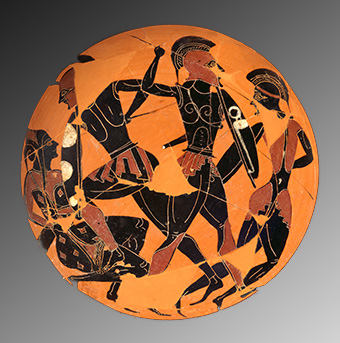
At the time, Athens had a fragile truce with Sparta, though skirmishes with Sparta’s allies continued. Nevertheless, the Athenian navy was free to take on other challenges. Only a few Athenians opposed the Sicilian expedition. One of them was the respected general and leader, Nicias [pronounced Knee-kias]. Nicias wasn’t a very good general, but he was a good person who put his country’s interests before his own. He told the Assembly:
I affirm, then, that you leave many enemies behind you here to go yonder and bring more back with you. You imagine, perhaps, that the treaty which you have made can be trusted; a treaty that will continue to exist nominally, as long as you keep quiet…but which in the event of a serious reverse would not delay our enemies a moment in attacking us…A man ought, therefore, to consider these points, and not think of grasping at another empire before we have secured the one we already have. (Bk VI, ch 18, 10)
Then he pointed out that the Sicilians “even if conquered, are too far off, too numerous to be ruled without difficulty.” Without mentioning any names, Nicias also warned the Assembly not to be misled by ambitious young leaders. “If there be any man here, overjoyed at being chosen to command, who urges you to make the expedition, merely for ends of his own…do not allow such a one to maintain his private splendor at his country’s risk.” It was clear he was referring to his rival, the brilliant but self-centered Alcibiades, the former student of Pericles and companion of Socrates. Thucydides says: Alcibiades was “exceedingly ambitious of a command by which he hoped to reduce Sicily and Carthage, and personally to gain in wealth and reputation by means of his successes.”
Alcibiades addressed the Assembly after Nicias. He began by reminding the Athenians of his victories on the battlefield and at the Olympics, victories which brought glory to Athens. He’d recently won first, second and fourth place in the chariot race by entering seven chariots. It was the first time anyone won so many prizes for the same event. Then he argued that Athens should take the offensive:
Men do not rest content with parrying attacks of a superior, but often strike the first blow to prevent the attack being made. And we cannot fix the exact point at which our empire shall stop; we have reached a position in which we must not be content with retaining but must scheme to extend it, for, if we cease to rule others, we are in danger of being ruled ourselves.
His argument prevailed. (What holes can you find in Alcibiades’ argument?)
Alcibiades and others assumed that the approach of the Athenian navy would encourage the common people in many Sicilian cities to overthrow their oligarchic governments and join them. Even Nicias agreed that Sicilian cities “in need of change” would “be glad to pass from enforced servitude to an easier condition, or in the least likely to accept our rule in exchange for freedom.”
In the summer of 415, 100 Athenian triremes carrying heavy Athenian infantry and fifty allied vessels set sail for Sicily under the command of Alcibiades, Nicias and Lamachus. Altogether about 30,000 men participated in the invasion. As the fleet approached its destination, Alcibiades recommended they win over as many allies as possible before attacking Syracuse. Nicias agreed. However, the seasoned warrior Lamarchus argued that they should attack at once before the Syracusans had time to prepare their defenses. But majority opinion ruled, and Lamachus’ sound advice was ignored. Poor leadership in general, along with Lamachus’ death and Alcibiades’ recall, led to the destruction of the entire Athenian navy.
Before the siege of Syracuse even started, Alcibiades was recalled, ordered home to stand trial for sacrilege. His enemies accused him of mocking the Eleusinian mysteries (religious rites honoring Demeter and celebrated in Eleusis), and they implicated him in a plot to overthrow the democracy. Alcibiades escaped before going to trial, and in his absence was condemned to death.
Since his nation had betrayed him, Alcibiades decided to betray his nation. He went over to Sparta and revealed the Athenians’ weaknesses and how to take advantage of them. His advice paid off—for the Spartans. For the tragic account of the destruction of the Athenian navy read Book 7 of Thucydides’ History.
by Jesse Bryant Wilder, Editor
NEXUS – PALLAS COMMUNICATIONS, INC.
© 2019 All Rights Reserved