
Romeo and Juliet Lesson 2
Guy Talk – Romeo Meets Paris

ASSIGNMENT – Write a New Scene for the play.
PREREQUISITES: READ Romeo and Juliet
LESSON OBJECTIVES: Improve your sensitivity to language; practice using vocal dynamics; learn how to effectively block a scene; recognize the role dialogue and character interaction (what is said and what is suggested) plays in advancing the plot.
MATERIALS: Word Processor (Word or Pages), pen, notebook, props, costumes, and music of your choice, a copy of Romeo and Juliet, a recording device
TASK: Add a scene (approximately the length of Act II, Scene 1) to Romeo and Juliet. Place the scene between Act II, Scene 6 and Act III, Scene 1; call it Act II, Scene 7 – BEFORE THE FATEFUL FIGHT. In this scene Romeo and Paris meet and discuss Juliet. Write the dialogue either in Shakespearean English or contemporary English. For either approach, the scripts must include a minimum of two Shakespearean-style antitheses, one pun and two metaphors (students may use similes and personifications as special types of metaphors). To help students write antitheses, puns and metaphors have them complete our HOW TO PEN PUNS, METAPHORS, AND ANTITHESES online lesson and see the NEXUS chapter “Word Games” in Romeo and Juliet and the Renaissance; in particular read the opening section on “Pun Ping Pong” and the section “Word Bridges.”
VOCABULARY: blocking, virtue, dynasty, heiress, court, gentility, aristocrat, pompous, profound, modulate
COMMON CORE STANDARDS MET WITH THIS LESSON:
CCSS.ELA-LITERACY.RL.9-10.3
Analyze how complex characters (e.g., those with multiple or conflicting motivations) develop over the course of a text, interact with other characters, and advance the plot or develop the theme.
CCSS.ELA-LITERACY.RL.9-10.4
Determine the meaning of words and phrases as they are used in the text, including figurative and connotative meanings; analyze the cumulative impact of specific word choices on meaning and tone (e.g., how the language evokes a sense of time and place; how it sets a formal or informal tone).
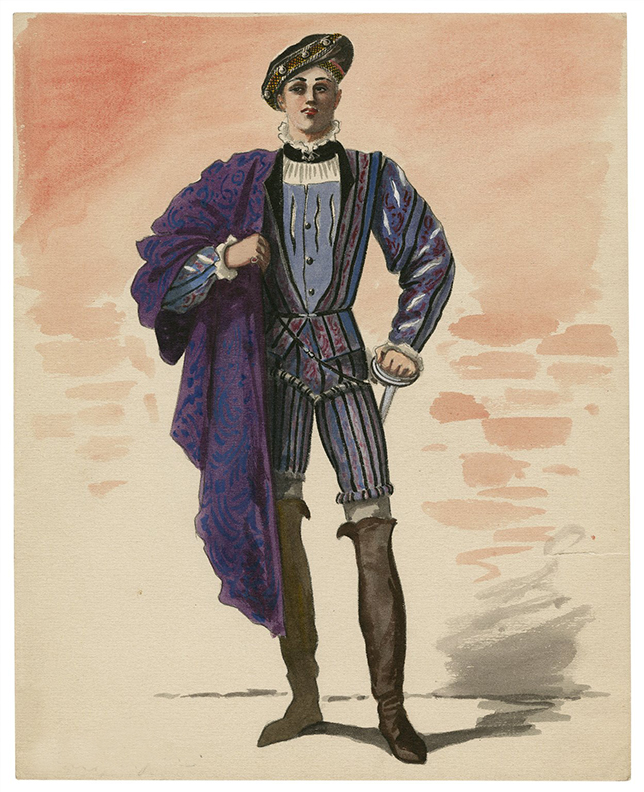
Image Courtesy of Folger Shakespeare Library
Writing Your Own Scene
STEPS:
DETAILS:
• Pair off with another member of your class,
• Choose who will play Romeo and who will play Paris.
• Then collaboratively plan and write your scene following the guidelines below.
• After the scene is written, you must memorize your lines and rehearse them multiple times.
• Both members of the team will collaboratively select costumes, props, and musical background and co-direct the performance.
• After writing and rehearsing your scene, in a two or three-paragraph essay, discuss how Romeo’s interaction with Paris showcases aspects of Romeo’s character and how the conversation between the two young men could affect the plot of the play (if your scene were actually incorporated into a production of Romeo and Juliet).
• Critique another team’s scene.
SCENE:
-
- In this scene Romeo meets Paris, and they discuss Juliet.
- MAKE SURE ROMEO STAYS TRUE TO CHARACTER IN YOUR SCENE.
- You will choose the setting.
- Write the dialogue either in Shakespearean English or contemporary English.
- For either approach, your script must include a minimum of two Shakespearean-style antitheses, one pun and two metaphors (you may use similes and personifications as special types of metaphors).
Scenario
SCENE: Shortly after Romeo marries Juliet, he encounters Paris either on the street or at Friar Lawrence’s cell (after Juliet’s departure – which Paris may or may not observe – you decide).
ASK YOURSELF THE FOLLOWING QUESTIONS AS YOU PLAN YOUR SCENE.
-
- Paris may have seen Romeo talking to Juliet during the Capulet feast. Would he be jealous, hostile?
- Would he warn Romeo to keep away from the girl he hopes to marry?
- Or would he assume that Romeo would never pursue the only child of his family’s sworn enemy?
- Would Paris talk about Juliet’s virtue and goodness or her beauty, gentility, and the key position she holds in the Capulet dynasty as the sole heiress of its leading member, Lord Capulet?
- How would Romeo react to Paris praising Juliet?
- Would Romeo be friendly or simply polite to the man who hopes to wed Juliet?
- In an effort to conceal his marriage, might Romeo encourage Paris to court Juliet?
- Would Romeo advise Paris to look for a more mature woman?
- Would Paris notice how joyful Romeo is? If so, how could Romeo account for his happiness without revealing its source?
- During the course of their conversation, is there anything Paris could say to Romeo that might change the outcome of the play?
DIALOGUE LESSON: Developing a Character’s Voice
SPEECH HABITS – HOW SHOULD YOUR CHARACTERS SPEAK?
- If you decide that Romeo and Paris will speak in Shakespeare’s English, use their manner of speaking in the play as a model for the dialogue you write.
- If you opt to have them speak in modern English, you must carefully decide on their choice of words. Remember, both young men are aristocrats, the crème de la crème of Verona society. Don’t make them talk like typical high school boys.
- Will Romeo respond to Paris in long sentences (perhaps to give his powerful feelings an outlet) or short (to hide his feelings or because he doesn’t want to speak to Paris)?
- Will Paris act superior to Romeo since he is the kinsman of the local Prince?
- Will Paris speak quickly to show his excitement with regard to Juliet or slowly in an effort to underscore his seriousness and high-mindedness?
- Paris is certainly as well-educated as Romeo. How will you show this? For example, would Paris engage in wit exchanges with Romeo like Mercutio does? (Remember, Paris and Mercutio are both kinsman of the Prince.)
- If Romeo and Paris were living in this century, they would speak like highly educated young men WITH LARGE VOCABULARIES.
- Would they punctuate every sentence with “like,” averaging 20 or more “likes” per minute like many people today? Or are they too self-confident and well-educated to use “like” as a punctuation mark or filler?
- Should the range of adjectives they employ be broad or narrow? For example, today many people use “amazing” to describe everything that’s extremely positive: Her outfit was amazing! The food at the Capulet feast was amazing! Juliet looked amazing! Or would they employ more variety in their choice of adjectives?
EVERYONE TALKS A LITTLE DIFFERENTLY. DON’T MAKE ROMEO AND PARIS SPEAK AS IF THEY WERE THE SAME PERSON.
Decide in advance what distinguishes Romeo’s language habits from Paris’s? For example, some people have favorite expressions that they frequently use. Often these expressions reveal things about the speaker’s character such as his interests, social class, educational background, etc. As a kinsman of the Prince, perhaps Paris always tries to appear neutral regarding the Capulet-Montague feud. Maybe he consistently weighs both sides of an issue like a good prince or ruler. Perhaps he is excessively polite and polished. Maybe he is pompous. Maybe he is less sincere than Romeo – or less romantic, less profound. All these things would affect his word choices and style of speaking. Make several tests by having Paris say the same thing in different ways. Which way seems truest to his character? Which is most interesting and most dramatic?
Brief Blocking Lesson
BLOCKING a scene means positioning the actors. The director must determine in advance where each character will stand or sit in relation to the other character(s) and where and how she or he will move.
MOVEMENT should help convey each character’s mood and feelings. For example, Romeo might look down or away when Juliet’s name is first mentioned by Paris.
POSITIONING can help show the relationship between characters: a person in charge might sit while the other character stands. When positioning characters, the director must also make sure that the audience can clearly see the actors.
Also remember that directors show actors at their most dramatic angles to intensify dramatic moments in a play or film.
Mini Lesson in Vocal Dynamics

VOCAL DYNAMICS refers to the changing of one’s pitch, volume and speed when speaking.
To make a scene seem natural, you must include vocal dynamics:
RAISING THE VOICE in anger or to get someone to focus on the point being made.
LOWERING THE VOICE so no one else overhears something controversial, dangerous, or compromising that the character might say.
SPEEDING UP (to show excitement or frustration) or slowing down a sentence.
PAUSING to emphasize a point and let it sink in – don’t ever say THAT….again.” Or pausing simply to let your thoughts catch up to your mouth.
We do ALL these things naturally, usually without thinking about them in conversation. Unfortunately, when reading or reciting dialogue, non-actors tend to leave out natural vocal dynamics. BE SURE TO INCLUDE THEM so your scene doesn’t sound flat and unnatural. In real life, no one speaks consistently at one volume and one tempo. Our voices modulate according to our moods and emotions. You might also include sounds like “hmmm,” “ah-ha,” laughs, chuckles, snickers, groans, etc.
To indicate vocal dynamics, we ask you to borrow the dynamics symbols of music:
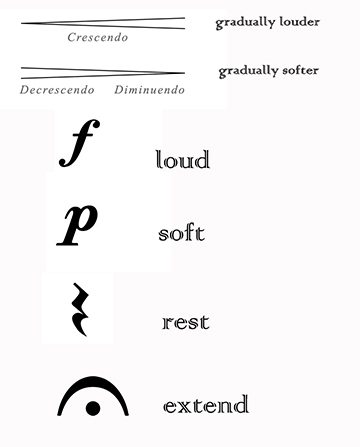
PRACTICE USING DYNAMICS SYMBOLS:
- Listen to a short conversation or record one on TV, if possible an interview. Then transcribe the text and add the above symbols in the appropriate places.
- Similarly, notate the vocal dynamics of Lord Capulet’s dispute with Tybalt at the party in Act I, Scene 5. You may use a film version of the play to help you or simply copy the text and place the symbols where you think they belong.
- Now you are ready to incorporate vocal dynamics into your script. Thoughtfully place the vocal dynamics symbols in your text, then practice using them. REMEMBER: You are NOT RECITING lines, you are putting life into them. But don’t overdo it (i.e., don’t overact).
RECORD SEVERAL REHEARSALS, THEN LISTEN CAREFULLY TO THE RECORDINGS TO DISCOVER WHERE YOU CAN IMPROVE THE SCRIPT, ACTING and VOCAL DYNAMICS.
PLAYWRIGHT AND TEACHER JEAN-CLAUDE VAN ITALLIE says that “It is commonly said that for any scene or play to be dramatic the characters must be in conflict. Conflict in a play has been called ‘the magic essential.’” What is the “MAGIC ESSENTIAL” in your Romeo/Paris scene?
Theater Critic
Learning from Reviewing and from Reviews
PART II
EACH STUDENT SHOULD CRITIQUE SOME OR ALL OF HIS CLASSMATES’ SCENES USING THE FOLLOWING CRITERIA:
A) How convincing and interesting is the dialogue?
B) If the dialogue is written in the style of Shakespeare, why is or isn’t it effective and well done?
C) If the dialogue is written in contemporary English, why is or isn’t it effective?
D) Are the characters true to Shakespeare’s creations? If not, how do they differ?
E) How convincing is the acting?
F) Is the blocking natural? Does it help to convey each character’s feelings?
G) Did both actors use vocal dynamics? If so, were the vocal dynamics realistic and natural?
H) Does the scene have a “magical essential”?
I) Offer suggestions for improvement.
NEXUS – PALLAS COMMUNICATIONS, INC.
© 2018 All Rights Reserved