

Macbeth Lesson 2
Contrasting Macbeth Soliloquies in Films and Stage Productions
RECOMMENDED: READ Act I of Macbeth
LESSON OBJECTIVES: Improve your sensitivity to language; practice using vocal dynamics; learn how to block a scene; recognize the role soliloquy (what is said and what is suggested) plays in advancing the plot and suggesting themes
MATERIALS: Word Processor (Word or Pages), pen, notebook, a copy of Macbeth, a recording device
VOCABULARY: trammel, surcease, shoal, commends, chalice, deed, borne, faculties, meek, cherubin, couriers, intent
TASK: Using the symbols below, map out and then interpret the vocal dynamics of film and staged versions of Macbeth’s first soliloquy. Then explain how delivering parts of the monologue in different settings – and in at least one case, a surprising setting – supports the text and contributes to the drama in the film versions. Finally stage your own interpretation of the soliloquy for your class and critique a partner’s rendition.
COMMON CORE STANDARDS MET WITH THIS LESSON:
CCSS.ELA-LITERACY.CCRA.R.7
Integrate and evaluate content presented in diverse media and formats, including visually and quantitatively, as well as in words.
CCSS.ELA-LITERACY.CCRA.R.2
Determine central ideas or themes of a text and analyze their development; summarize the key supporting details and ideas.
CCSS.ELA-LITERACY.RL.9-10.4
Determine the meaning of words and phrases as they are used in the text, including figurative and connotative meanings; analyze the cumulative impact of specific word choices on meaning and tone (e.g., how the language evokes a sense of time and place; how it sets a formal or informal tone).
CCSS.ELA-LITERACY.CCRA.R.6
Assess how point of view or purpose shapes the content and style of a text.
Image of Edwin Booth as Macbeth, Courtesy of Folger Shakespeare Library
MACBETH LESSON – Part I
Comparing Two Film Versions and One Staged Production of Macbeth’s First Soliloquy
For this lesson you will need a copy of both Roman Polanski’s and Justin Kurzel’s Macbeth films (or you may substitute the Orson Welles Macbeth for one of these versions). The staged production is available online. Also, you will need to watch this video of Michael Fassbender and Justin Kurzel discussing Fassbender’s role as Macbeth.
QUESTIONS/ACTIVITIES:
- Reread Macbeth’s first soliloquy, then write a summary of it.
- Watch Macbeth’s first soliloquy in Roman Polanski’s Macbeth, in Justin Kurzel’s Macbeth, and at this Youtube link − https://www.youtube.com/watch?v=GAAnAB3A3PQ − which features Ian McKellen’s version of the soliloquy for a Royal Shakespeare Company stage production. Which version do you prefer and why?
- Which soliloquy setting do you prefer and why?
- The positioning of an actor (determined by the director) is called blocking. Is the blocking of the soliloquy more dramatic in the Polanski or the Kurzel film? Why? In which version is the blocking more realistic? In which is it more stylized (look up this word if you’re unfamiliar with it)? Explain your answers.
- Which theme(s) in the play does Macbeth’s soliloquy reflect? Cite and then interpret at least two lines that reflect this or these theme(s).
- Dramatists build suspense by stimulating feelings of nervous expectation and dread in audiences. What lines in Macbeth’s soliloquy build suspense? How do they achieve this?
- In your opinion, which delivery best reflects the emotional and psychological state of Macbeth at this point in the play? Do any parts of Jon Finch’s, Michael Fassbender’s, or Ian McKellen’s delivery detract from the overall drama? If so, how would you recommend changing those parts? Which parts in each version seem especially dramatic? Why?
- Which lines indicate that the character speaking them has a conscience?
- Interpret Macbeth’s insight – “This even-handed justice/Commends th’ingredience of our poison’d chalice/To our own lips.” Give an example from life that supports your interpretation – in other words, how does the injury you do to another, boomerang back on you in this life?
- For this question, pretend you are the director or script writer of the Polanski film and then the Kurzel film. Justify the cuts in the text in each case. In other words explain why they were necessary and how eliminating them helped you realize your cinematic vision of the play. In addition, for the Polanski film, explain how each location in which Macbeth delivers his lines enhances the drama.
- Which version of the soliloquy conveys the music of Shakespeare’s language most effectively? Why?
- Which version reflects the subject matter best? Why?
- Which version builds drama more intensely? Explain your answer. Do any of the versions dilute the drama?
- Which film soliloquy is easier for the audience to understand?
- Are the tempos of each soliloquy appropriate to the thoughts and feelings expressed? Is one actor too slow or too fast in places? If so, where and why? [Discuss all three versions in your answer.]
EXTRA CREDIT: Read “Royal Murder and The Real Macbeth” in Macbeth and the Dark Ages, NEXUS. Then, based on your reading, in one or two paragraphs explain why you think Shakespeare’s portrayal of Macbeth accurately or inaccurately conveys the spirit of the real Macbeth.
Part II – Vocal Dynamics Lesson
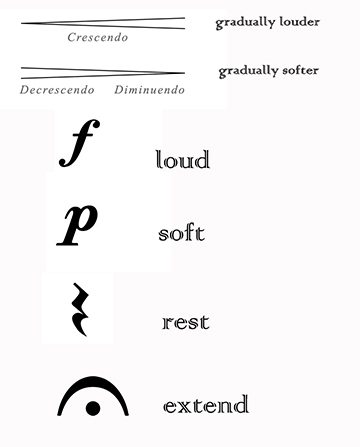
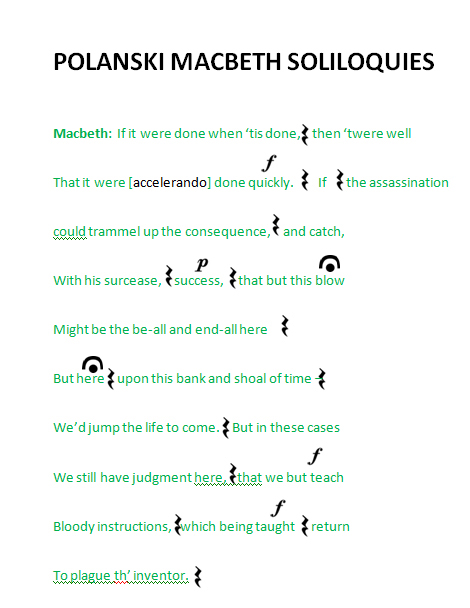
Write out or copy Macbeth’s first soliloquy from Shakespeare’s play, double-spacing the text. Then make three more copies of the soliloquy. You should have a total of FOUR copies. Use the musical symbols below (soft, loud, gradually louder, etc.) to map the vocal dynamics in three versions of the soliloquy, one by Jon Finch in Roman Polanski’s Macbeth, one by Michael Fassbender in Justin Kurzel’s Macbeth, and one staged rendition by Ian McKellen, a former member of the Royal Shakespeare Company. Then create your own version of the speech. GIVE YOUR MACBETH A SPECIFIC ATTITUDE, then, as you map out his vocal dynamics, inflect Macbeth’s speech to best convey that attitude. Use the above versions of the soliloquy as models; but DO NOT imitate them. Remember, in his interview, Michael Fassbender points out that “there’s a thousand other ways to do that scene; it’s never ending.” Finally perform ten lines of your soliloquy for your class and critique the soliloquy of another student.
What are Vocal Dynamics?
When a parent wants a teenager to clean her or his room (which has NOT been properly cleaned in weeks), she might yell, “CLEEAAN your room” prolonging the word she wants to stress. Or, she might shout that word: “Clean!” Or she might say, “clean…YOUR…room” to emphasize that it is YOUR responsibility to keep YOUR room clean.
TO MAKE A SCENE SEEM NATURAL YOU MUST INCLUDE VOCAL DYNAMICS:
-
- RAISING THE VOICE in anger or to get someone to focus on the point being made.
- LOWERING THE VOICE so no one else overhears something controversial, dangerous, or compromising that the character might say.
- SPEEDING UP (to show excitement or frustration) or slowing down a sentence.
- PAUSING to emphasize a point and let it sink in – don’t ever say THAT….again.” Or pausing simply to let your thoughts catch up to your mouth.
- We do all these things naturally, usually without thinking about them in conversation. Unfortunately, when reading or reciting dialogue, non-actors tend to leave out natural vocal dynamics. BE SURE TO INCLUDE THEM so your scene doesn’t sound flat and unnatural. In real life, no one speaks consistently at one volume and one tempo, giving each word equal weight. Our voices modulate according to our moods and emotions. You might also include sounds like “hmmm,” “ah-ha,” laughs, chuckles, snickers, groans, etc.

ACTIVITIES:
- On the first copy of the soliloquy, map the vocal dynamics Michael Fassbender uses in his version. Cross out the lines in the soliloquy that he doesn’t speak. DOES HIS TEMPO HELP TO REVEAL HIS FEELINGS? HOW? Use the sample above to help you map the actor’s vocal modulations. Feel free to modify our mapping of his voice. Voice differentiation is sometimes very subtle and can include changes in pitch (which our system doesn’t take into account), therefore vocal dynamics notation is an approximation and should be viewed as a rough sketch of an actor’s vocal dynamics. STUDENTS should notate with a pencil on paper (they will probably make changes). Using a word processor to notate is very tedious and cumbersome.
- On the second copy, map the vocal dynamics Jon Finch uses in his soliloquy. Cross out the lines he doesn’t speak. DOES HIS TEMPO HELP TO REVEAL HIS FEELINGS? HOW?
- On the third copy, map the vocal dynamics that former Royal Shakespearean actor Ian McKellen uses in his rendering of the monologue: https://www.youtube.com/watch?v=GAAnAB3A3PQ
-
-
- What effect does speaking particular words softly have? Give examples from all three monologues.
- Similarly what effect does speeding up or slowing down have in each speech?
- Where and why do the actors pause? One of the actors might pause to reflect on what he’s just said or to savor a feeling or to let it sink in. In another part of the speech, an actor might pause because he is discovering new ideas as he speaks? Could there be other reasons? Interpret two pauses in each of the actors’ deliveries.
- Similarly what effect does speeding up or slowing down have in each speech?
-
PART III – Blocking and Setting Lesson
BLOCKING a scene means positioning the actors with respect to one another and their location (the setting). They might be sitting, standing or lying down, looking up or down, etc. The director must determine in advance where each character will stand or sit in relation to the other character(s) and where and how she or he will move – even when alone.
MOVEMENT should help convey each character’s mood and feelings.
POSITIONING can help show an actor’s attitude, the effect of the surroundings on his or her mood, the relationship between characters: a person in charge might sit while the other character stands. When positioning characters, the director must also make sure that the audience can clearly see the actors.
Also remember that directors show actors at their most dramatic angles to intensify dramatic moments in a play or film.
SETTING – location and ambiance can help convey mood, indicate social and economic status (expensive furniture in a house versus dilapidated furniture), and even affect behavior (someone watching a baseball game in a stadium will usually behave quite differently than someone in a church, mosque or synagogue).
QUESTIONS:
-
-
- Compare the blocking in the two film versions. Which do you prefer and why?
- Does the blocking in the Polanski film help convey Macbeth’s attitude?
- Does the blocking in Kruzel’s film help convey Macbeth’s attitude and mood? If so, how?
- Compare the settings in the two films. Does each setting seem appropriate to the style, manners, and emotions of that particular Macbeth?
- If you were directing the film, what might you have done differently?
-
PART IV – YOUR MACBETH CHARACTER
PERFORMANCE – MAPPING YOUR VOCAL DYNAMICS
NOW IT’S YOUR TURN TO CREATE A MACBETH. ON YOUR FOURTH COPY OF THE SOLIOQUY, YOU WILL DECIDE WHICH WORDS SHOULD BE EMPHASIZED AND HOW BEST TO EMPHASIZE THEM. CHOOSE TEN LINES FROM MACBETH’S FIRST SOLILOQUY TO PERFORM. THEN, USING THE SAME MUSICAL DYNAMICS SYMBOLS, MAP OUT (INDICATE) THE VOCAL DYNAMICS YOU WILL USE IN YOUR PERFORMANCE.
FIRST, give your Macbeth a unique attitude that makes sense psychologically. Then infuse the monologue with the feelings that drive this attitude and map your vocal dynamics accordingly. Does he speak rapidly (at times or always) because he’s not considering all the consequences of his plan? Does he speak forcefully at times because he is beating back doubts or qualms of conscience? Remember, your Macbeth is fighting against an undercurrent of conscience, which he slowly suppresses.
MEMORIZE YOUR LINES AND PRACTICE THEM USING THE DYNAMICS YOU’VE MAPPED. DISTRIBUTE COPIES (OR POST A COPY) OF YOUR DYNAMICS MAP (UNDER THE TEXT) SO THAT THE OTHER STUDENTS IN YOUR CLASS CAN JUDGE WHETHER YOU’VE FOLLOWED YOUR DYNAMICS MAP WHILE YOU ARE PERFORMING THE SCENE.
PERFORMANCE HINT: TO HELP YOU CREATE A UNIQUE PERFORMANCE, THINK OF SOMETHING THAT YOU GREATLY DESIRE. WHEN SAYING THE LINES, IMAGINE THAT YOU ARE TALKING TO YOURSELF ABOUT THIS DESIRE. BUT OF COURSE YOU MUST TRANSLATE YOUR DESIRE INTO MACBETH’S DESIRE AND USE SHAKESPEARE’S WORDS.
Remember, Michael Fassbender says, regarding his role as Macbeth, “Definitely I had to find something that was a personal connection for me to Shakespeare and to that piece.”
PART V –THEATER CRITIC
Learning from Reviews and Reviewing
WRITE A BRIEF REVIEW OF A CLASSMATE’S SOLILOQUY.
-
-
- Is your partner’s Macbeth true to Shakespeare’s creation? If not, how does your partner’s Macbeth differ?
- Did your partner give a specific and unique attitude to Macbeth? If so describe that attitude.
- Is this attitude reflected in all his/her voice inflections during the monologue?
- How effective were your partner’s overall vocal dynamics? Explain and give examples.
- Did your partner closely follow his or her vocal dynamics map?
- How could your partner’s presentation be improved?
- How convincing was his/her acting?
- Is the blocking natural? Does it help to convey Macbeth’s feelings?
- Describe the blocking.
- How could the blocking be improved?
-
EXTRA CREDIT:
- In one or two paragraphs explain what you’ve learned from being reviewed and from reviewing your peer’s performance.
- In a few paragraphs explain what you learned from closely studying the three actors’ versions of the soliloquy.
NEXUS – PALLAS COMMUNICATIONS, INC.
© 2018 All Rights Reserved